
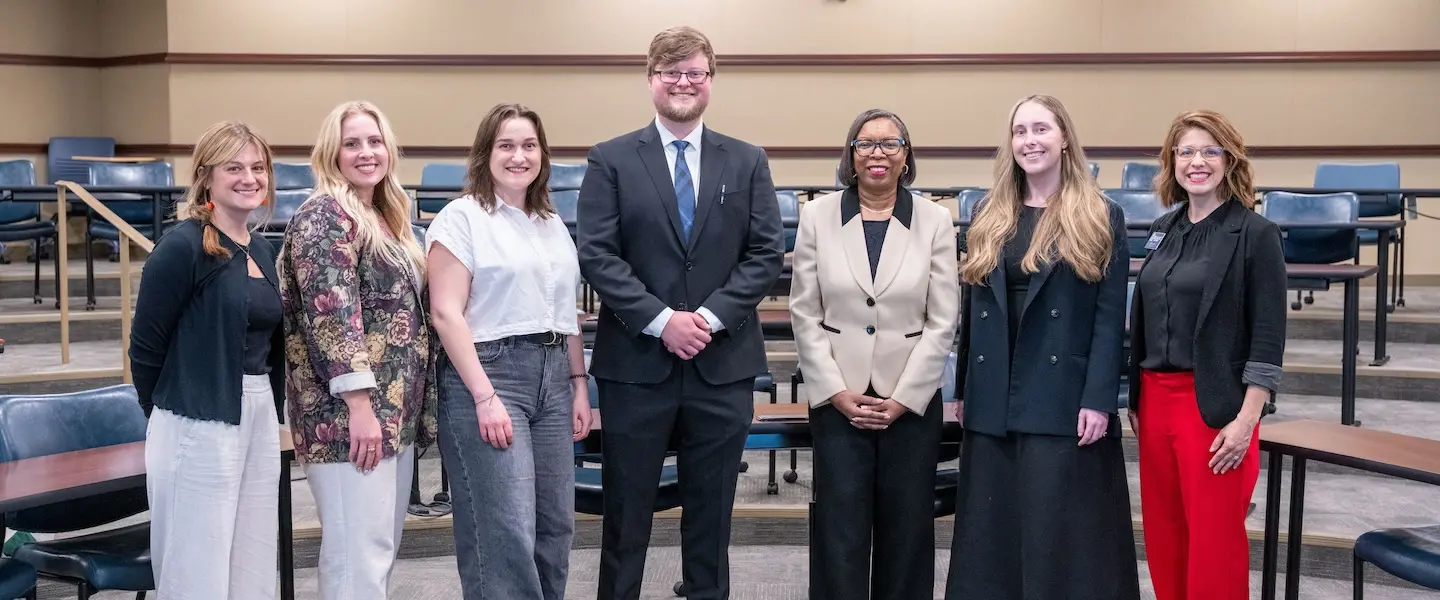
New partnership expands hands-on mediation training while filling a critical gap in Middle Tennessee legal education
Belmont University’s College of Law successfully piloted a new Conflict Resolution Clinic embedded at the Nashville Conflict Resolution Center (NCRC) during the 2026 spring semester. Highly requested by students, the new offering builds upon their experiential learning education and their introductory foundation in alternative dispute resolution (ADR).
The Conflict Resolution Clinic focuses on mediation in a hybrid clinic model sited at NCRC, a local nonprofit that provides resources for court-ordered mediation in civil, family and domestic violence cases.
The partnership arrives at a moment when demand for ADR-trained attorneys has never been higher.
The Case for ADR
Most cases today (90-98%) are settled through alternative dispute resolution, a term referring to processes that help parties resolve their case outside of the courtroom including mediation, negotiation or arbitration. This staggering reality underscores the value of Belmont Law’s new experiential learning option.
“Even if you are a litigator and you are trained to go to court, you absolutely must have alternative dispute resolution skills to practice litigation, because a lot of cases settle outside of court,” said Kristi Arth, assistant dean for experiential learning.
Prior to the clinic, law students gained ADR experience through an adjunct-led ADR survey course and elective courses including mediation and negotiations practicum — both taught by Dr. Tracey Carter, a longtime champion for dispute resolution education at Belmont Law and the founding director of dispute resolution.
Carter stepped in as the instructor for the course component of the Conflict Resolution Clinic while already successfully teaching the elective courses in mediation and negotiations practicum for many years.
Filling a Regional Gap
While exploring ways to continue building Belmont Law’s alternative dispute resolution offerings, Carter made an interesting discovery.
While law schools in East and West Tennessee have a track record of community mediation clinic partnerships, there weren’t any directly serving Middle Tennessee in this capacity.
“This is the first law school/community-based mediation clinic partnership in Middle Tennessee,” Carter said. “No other law schools were doing it locally. When I discovered that our region didn't have any kinds of partnerships like this, I knew we had to jump on it.”
As a licensed attorney and Rule 31 Tennessee Supreme Court Listed General Civil Mediator, Carter’s loose association with NCRC provided an onramp for establishing the Conflict Resolution Clinic partnership with the nonprofit. Due in large part to Carter’s efforts, Belmont Law’s Conflict Resolution Clinic now serves as the first partnership of its kind in Middle Tennessee.
“This partnership with Belmont Law is meaningful to NCRC because it sits right at the intersection of access to justice and community impact,” said Shannon Wagner, NCRC executive director. “By engaging law students in community-based mediation, we’re not just expanding capacity; we’re strengthening a culture of resolution in Nashville. It creates a bridge between legal education and real-world community needs, ensuring that future attorneys understand both the human side of conflict and the power of early, constructive intervention.”
Building on a Proven Model
In addition to expanding Belmont Law’s alternative dispute resolution offerings, the Conflict Resolution Clinic adds to the number of community clinics facilitated through the experiential learning program.
The Healthcare Justice Clinic at the Tennessee Justice Center marked Belmont Law’s first step into an embedded community clinic model. Now in its 2nd year, the clinic has become a valuable blueprint for launching the experiential learning program’s second clinic in that same model where students complete a community partner site and also participate in a seminar a course built around the clinic’s particular specialization.
“It is critically important for law students to be trained in mediation and alternative dispute resolution before entering the profession because it fundamentally shapes how they approach conflict,” Wagner said. “Early exposure to mediation helps future attorneys see the value of collaboration, empathy and creative problem-solving. It equips them with tools to de-escalate, to listen more effectively and to pursue outcomes that are more sustainable for everyone involved. Ultimately, it builds a legal community that is better prepared to serve people and not just cases.”
Inside the Pilot Semester
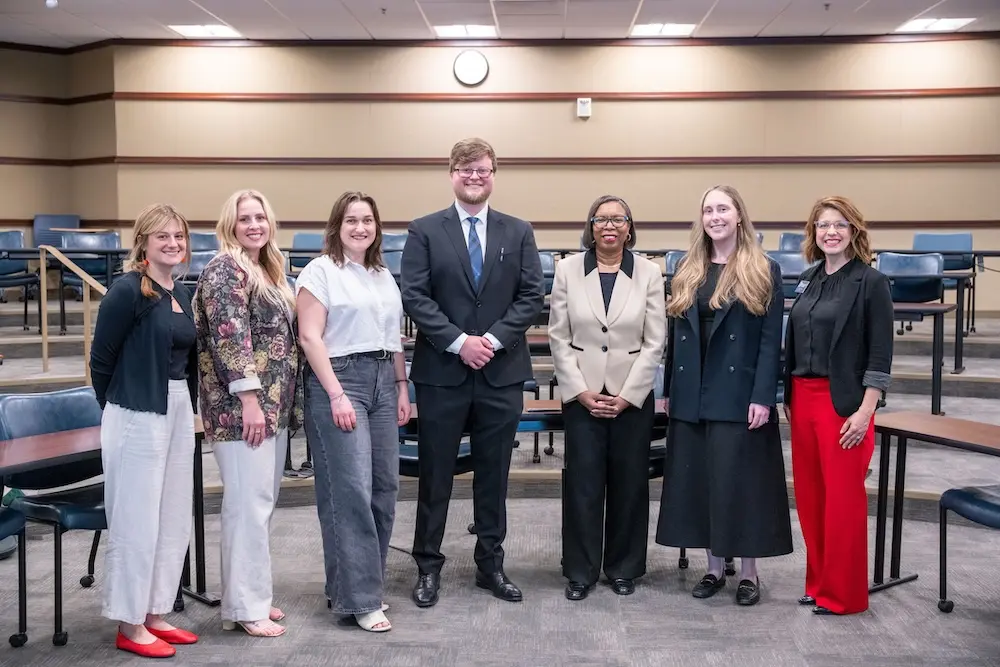
With two third-year law students (Nick Hayden and Catharine Fennell) selected by Carter for the inaugural cohort, the pilot semester of the Conflict Resolution Clinic laid a strong foundation for the future of the partnership.
Student Requirements
As an advanced experiential learning placement, students applying to the clinic must meet two prerequisites for consideration:
- Taken either ADR , negotiations practicum or mediation
- Previously had at least one experiential learning placement
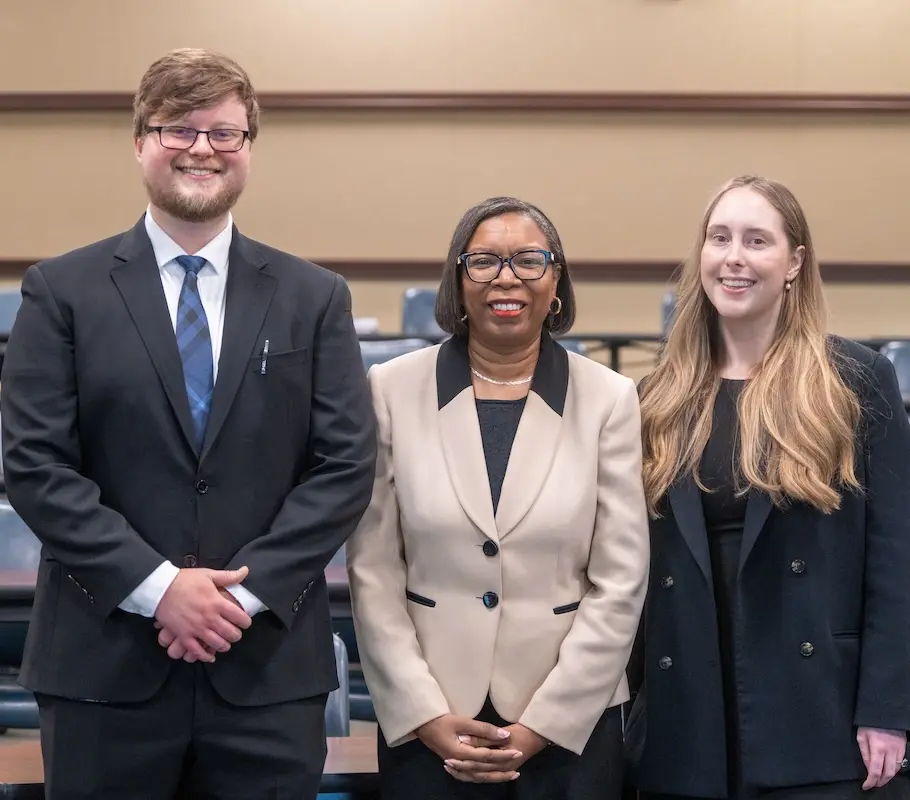 The students each obtained at least 100 hours in the placement, regularly observing mediations led by NCRC mediators and researching topics provided by NCRC that resulted in two fully developed oral presentations and two executive summaries.
“Something I learned through this work that I didn’t expect is how much empathy can impact parties in disputes,” said Hayden. “During my observations, I noticed that multiple individuals’ moods lifted after the mediator let them vent and expressed empathy for their struggles, even if the mediation did not result in a settlement. Many parties want to feel heard and respected, and mediation can provide that opportunity, regardless of settlement outcome.”
In future semesters, students will move from an initial observation period to the co-mediation stage. During the pilot semester, Carter completed NCRC’s extensive onboarding and is now an official volunteer. This will help create opportunities for students to begin co-mediating.
Deepening Impact Beyond the Classroom
The previously untapped experience of working with NCRC proved highly effective for both students and the nonprofit. To close the semester, NCRC invited Carter, assisted by Hayden and Fennell, to lead a lunch-and-learn focused on "Bargaining Styles and the Psychology of Negotiations,” which drew record attendance.
“Through this clinic, I saw how emotional conflict can hide behind legal disputes in court,” Fennell said. “When real legal consequences are on the line, people come to court to address conflicts but do not come prepared to sit down and talk it out. I watched many mediators employ different tactics to address the disputes at hand, but the most memorable mediations included mediators who focused on the parties as people who need another perspective to see eye-to-eye again.”
The Conflict Resolution Clinic not only highlights Belmont’s growing experiential learning program but also is an example of the College’s attentiveness to student and alumni concerns and requests. As Belmont Law continues building, developments like these will help continue distinguishing the legal education provided.
Learn more about the programs in this story.