

What is Ethical Intelligence?
Ethical Intelligence is a critical competency for professionals navigating complex decisions, stakeholder relationships and organizational challenges. This approach illustrates how four foundational attributes— Moral Character, Reasoning, Responsibility and Compassion—intersect to form ethical intelligence. Cultivating these traits enables professionals to lead with integrity, foster trust and make decisions that align with both organizational goals and societal values.
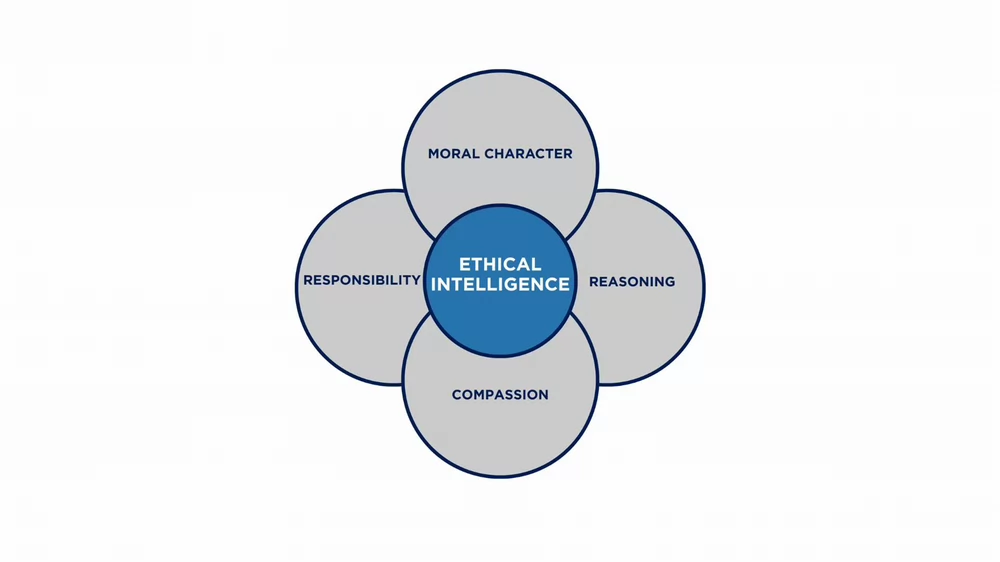
The Four Foundational Attributes
Moral Character
Moral Character is the ability to uphold core values and ethical standards in all professional and personal actions.
- Moral character begins with looking internally.
- Who are you as a person? What are your virtues? How do these virtues manifest themselves as habits?
- Where does this foundation come from?
- Character is the foundation that builds wisdom.
- Wisdom is how one increases ethical intelligence.
- These components work together as a cycle.

Responsibility
Responsibility is owning decisions and their consequences, even under pressure.
- Responsibility serves as a precondition for ethical intelligence.
- We are “responsible agents,” which includes being able to reason, make choices and being accountable for our decisions.
- We face situations where our decisions and actions bear some responsibility even without full control over those situations.
- Where does this foundation come from?
- Acknowledging mistakes rather than deflecting
- Following through on commitments
- Anticipating consequences and outcomes
- Making amends
- Responsibility is understanding our role, what we are responsible for, and to whom.
- Wisdom is how one increases ethical intelligence.
- Ethically intelligent people take responsibility for their own ethical development—through educating themselves, identifying, acknowledging and mitigating for their own biases and seeking feedback.
Reasoning
Reasoning is applying critical thinking and logic to evaluate ethical dilemmas.
- Reasoning is the core cognitive engine of ethical intelligence.
- It takes us beyond visceral reactions and snap decisions. Aristotle’s concept of phronesis (practical wisdom) allows us to use our moral character alongside experience (logical skill) to make decisions.
- Allows us to navigate increasingly complex ethical dilemmas.
- Virtue Ethics: The actor is emphasized
- Duty Ethics: The action is emphasized
- Utility Principle: The outcome/consequence is emphasized
- Justice Ethics: The distribution of benefits and burdens
- Reasoning allow ethical intelligence to handle complexity and ambiguity. Not every dilemma or decision is as clear as the previous one or the next.
- Reasoning is more developed when persons of high moral character understand their role and responsibility when facing ethical dilemmas.

Compassion
Compassion is understanding others’ perspectives with an intent to foster collaboration and inclusivity through action.
- Compassion is a true human-centered element that can’t be replicated by technology.
- Compassion allows us to see that there is something significant happening in the first place.
- Compassion helps us to understand the stakes, potential impacts, and the incentives and conditions that are present.
- Empathy is a powerful trait that can help us identify ethical dilemmas and provide motivation to do something about it, but compassion requires guidance from reason, responsibility, moral character and self-awareness to function well.
- Although it may not be strictly necessary for ethical behavior, it is a core component of ethical intelligence.
- Compassion incorporates the heart in a process but protects against making decisions based only on feelings, which may include bias in decisions.
- Compassion is connected to all other elements—it is a virtue in character, expands a sense of responsibility and provides a clearer orientation in reasoning.
How can we use Ethical Intelligence?
Ethical Intelligence Integration
Moral Character, Responsibility, Reasoning and Compassion.
Each element of Ethical Intelligence needs to be developed both individually and collectively.
Sophisticated ethical intelligence integrates all elements:
- Moral Character provides the stable foundation
- Responsibility defines the normative framework and establishes you as an agent
- Reasoning provides navigation and reflection
- Compassion provides an orientation of care
The most ethically intelligent responses often combine compassion’s motivational force and care orientation with reasoning’s clarity, responsibility’s scope and character’s reliability.