

What is the MOSAIC Framework?
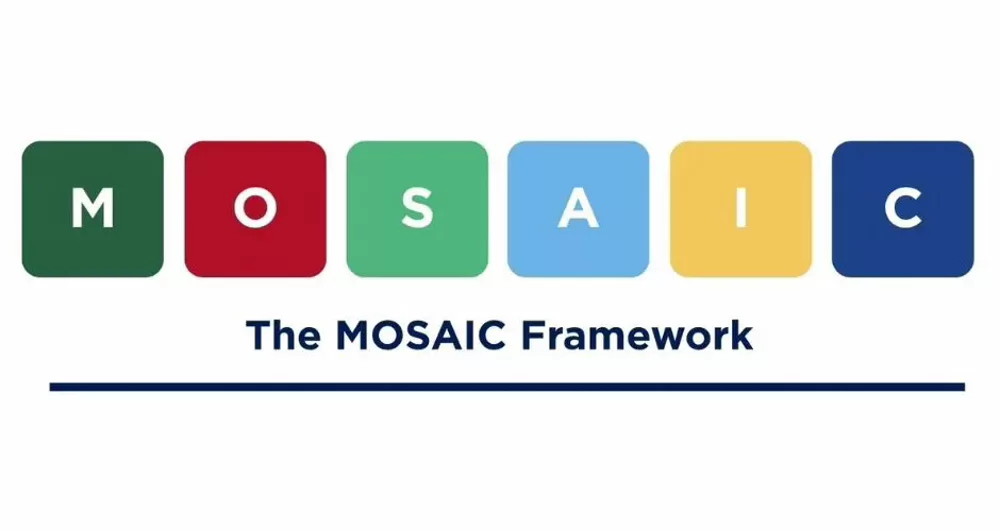
The MOSAIC Framework is intended to provide businesses and organizations a comprehensive approach to creating conditions for more ethical decisions, both as part of a framework for cultivating ethical culture and as a tool for strengthening the “moral muscle”* of those within the organization to improve ethical decision-making. It is a structured approach that can be used to navigate complex moral dilemmas with clarity, confidence and consistency.
Like pieces of a mosaic that come together to form a complete picture, each element contributes to a comprehensive ethical analysis and culture. The ability to implement an ethical decision-making process within an organization’s culture is key to making both decisions that require urgency and those that provide for more time and discussion. Ethical intelligence is just as important in an organization as intellectual and emotional intelligence.
This framework can be used in any organizational setting. Maybe most importantly, it represents a wholistic process for building a culture; it is not intended to be prescriptive, exhaustive, nor exclusive.
*Courtesy: Dr. Shannon Vallor

Moral Foundation
Establish your ethical base by defining your mission, core values, ethical principles, and legal frameworks. Identify the core ethical principles at stake.
Examples:
- Integrity: Adhering to a set of moral standards
- Honesty: A commitment to telling the truth
- Respect: Treating others with respect, creating a culture where each voice matters
- Responsibility: Maintaining ownership of actions, processes, and outcomes
- Accountability: All members of the organization are held to consistent standards for their actions, their work, and the organization’s products and/or services
Key question: Which moral principles are most relevant or most at risk in this decision?

Outcomes
Analyze potential outcomes and their impact. Consider timeframe of decision, direct effects, indirect effects, magnitude, probability, and reversibility.
Examples:
- Timeframe: Consider both immediate and long-term outcomes
- Direct effects: What will happen immediately as a result of each option for action
- Indirect effects: What ripple effects might occur over time?
- Magnitude: How significant are the potential positive and negative outcomes
- Probability: How likely are different outcomes to occur?
- Reversibility: Can negative consequences be undone or corrected?
Key question: What are the likely outcomes of each possible action, and who will be affected?

Stakeholders
Identify all stakeholders who may be impacted, both directly and indirectly. Consider primary and secondary stakeholders, future stakeholders, organizational stakeholders, including stakeholders who are part of vulnerable populations. Who within your organization is part of the decision-making process?
Examples:
- Primary stakeholders: Those directly affected by a decision
- Secondary stakeholders: Those indirectly impacted
- Future stakeholders: People who may be affected over time
- Organizational stakeholders: Institutions, communities, or systems involved
- Vulnerable populations: Groups that may be disproportionately impacted
Key question: Who are all the people and groups that could be affected by a decision?

Actions
Generate and evaluate different courses of action. Identify creative solutions, compromise
positions, phased approaches, alternative timing, and collaborative options. Consider the option of taking no action.
Examples:
- Existing infrastructure: Are there existing systems and/or solutions that can be applied?
- Creative solutions: Are there innovative approaches that have not been considered
- Compromise positions: Can competing interests be balanced?
- Phased approaches: Could the decision be implemented gradually?
- Alternative timing: Would acting sooner or later change the ethical calculus
- Collaborative options: Could involving others lead to better solutions?
Key question: What are all the possible ways to address this situation, including creative alternatives?

Incentives
Examine the underlying incentives, intentions and motivations behind each option. Are there personal motivations, organizational pressures, hidden agendas, and/or character/brand implications.
Reflect honestly on what drives each potential decision:
- Personal motivations: What are a person’s own interests and biases, including your own?
- Organizational pressures: What external forces might be influencing a decision
- Hidden agendas: Are there unstated motivations at play?
- Character/brand implications: What kind of person/organization would the decision reflect?
Key question: What are the true incentives behind each option and are they ethically sound?

Conditions
Consider the situational factors that shape the ethical landscape. Consider the cultural context, legal perspective, historical context, resource constraints, urgency, and power dynamics and other potential tensions. It is important to not allow conditions to be the strongest driver of a decision or in building a culture, but it would be insufficient not to consider and understand the conditions that are present.
Examples:
- Cultural context: How do cultural norms and values influence the situation?
- Legal framework: What legal requirements or restrictions apply?
- Historical context: What precedents or past experiences are relevant?
- Resource constraints: How do practical limitations affect available options?
- Urgency: How does time pressure impact the decision-making process?
- Power dynamics: What inequities or authority relationships are present?
Key question: What specific contextual factors must be considered to fully understand the ethical dimensions of this situation?